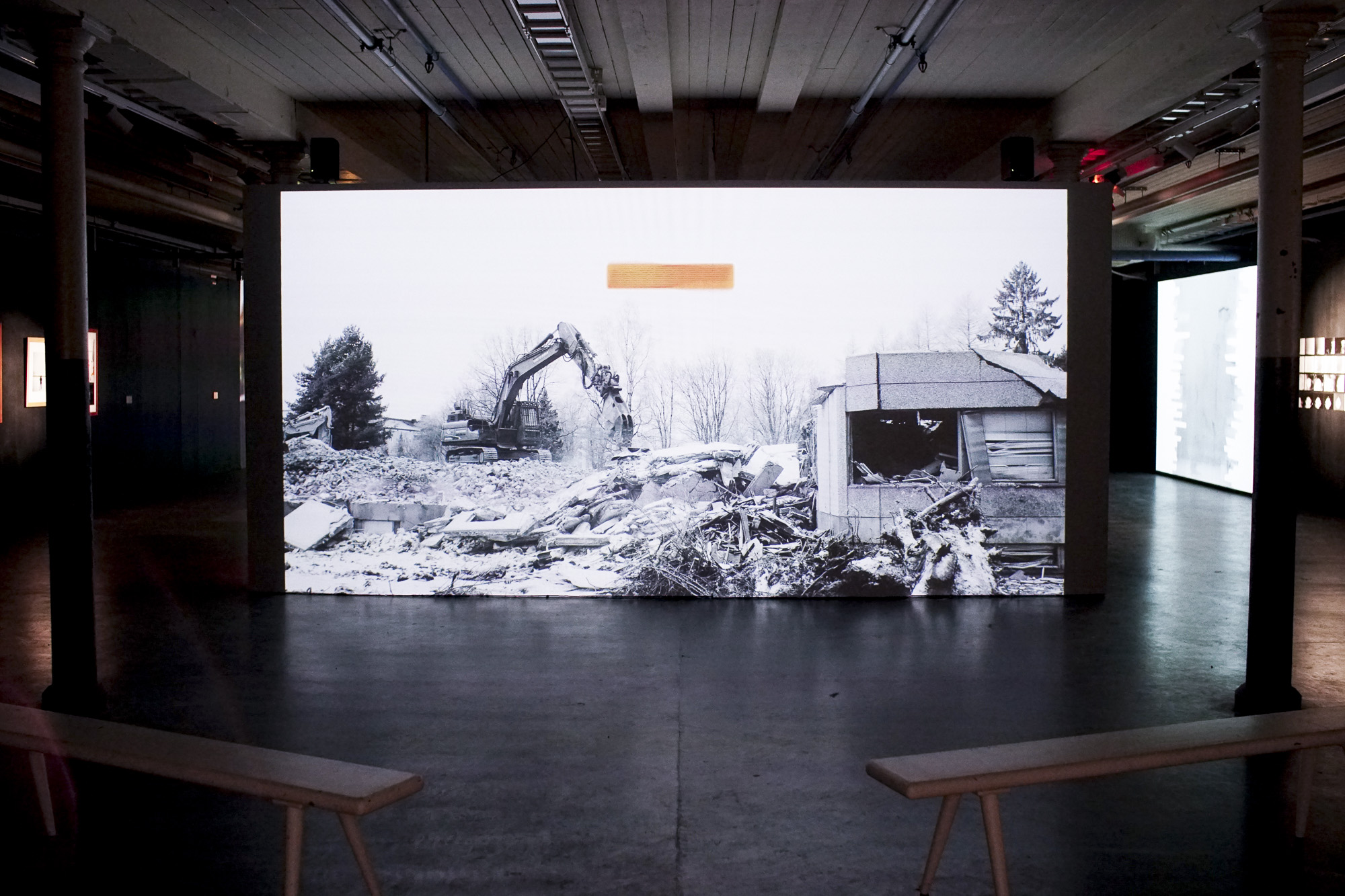
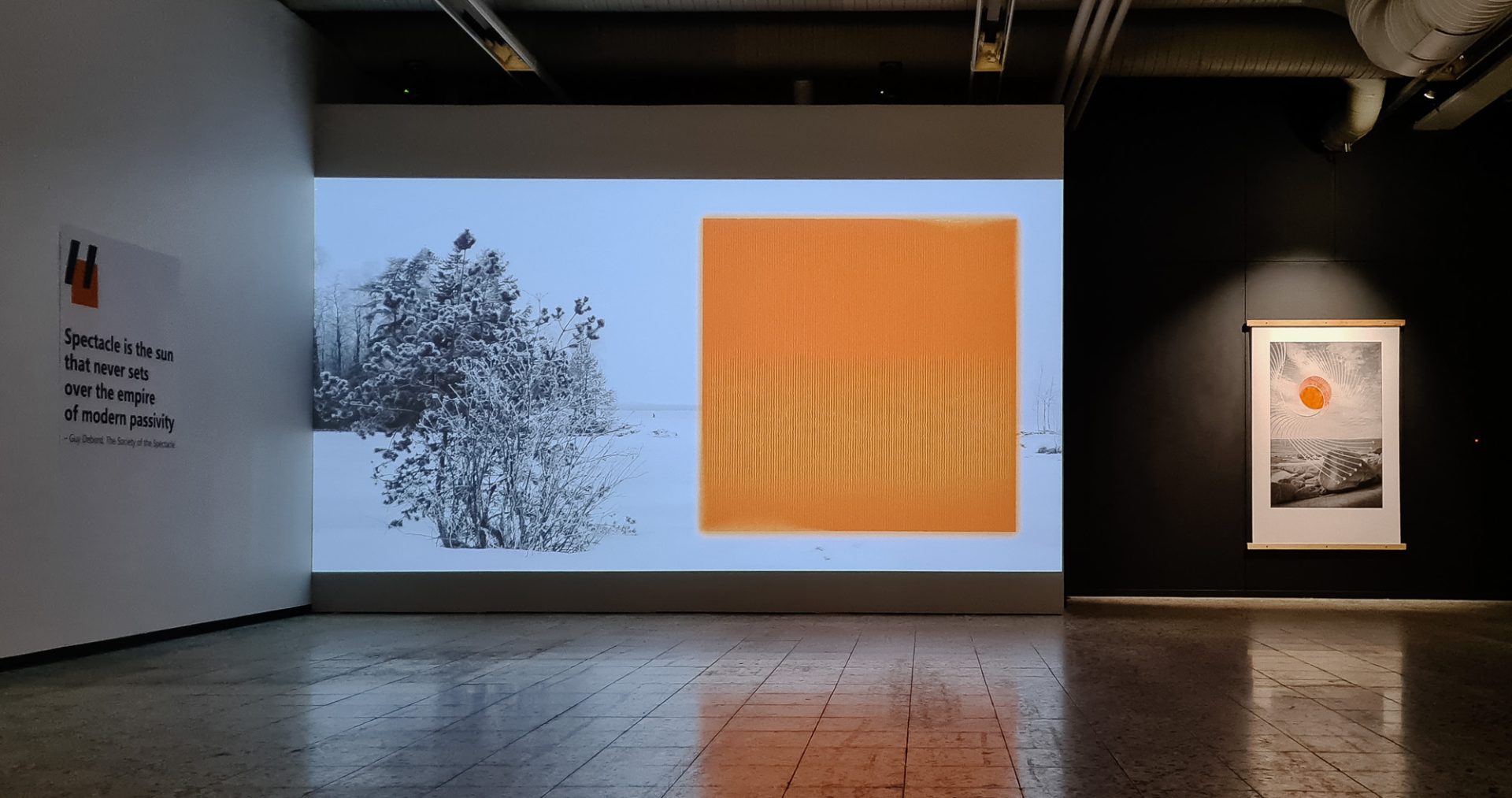
In Sami Sakari’s video installation, the relationship between image and content is seamless. Together with the soundscape, they form a cohesive whole that feels both assured and professionally crafted. The work draws conceptual support from a quote by Guy Debord, taken from The Society of the Spectacle:
“The spectacle is the sun which never sets over the empire of modern passivity.”
The video’s sequence of scenes unfolds as slowly shifting tableaux. They show faded, time-worn views in which the eye is continually drawn to an orange square or rectangle. This vibrating shape glows with intensity, heightening the visual tension. It insists on being noticed, until it finally consumes the image from within.
The pre-selected contents that various screens offer us pull us ever further into their world. As we participate in the spectacle, we risk losing ourselves, our position, even our physical sense of place, within a shared, mediated reality. Sami Sakari succeeds in giving form to this widely discussed theme in a fresh and inventive way, relying boldly on the strength of his visual vision.
Laura Kuurne, Head of Collections and Exhibitions, Serlachius Museums (Translation by the artist)
Spectacle is the Sun is a single-channel video installation that examines how mediated images reorganize attention and perception. The work stages a gradual shift in which the surrounding environment becomes visually depleted, while a screen-like presence increasingly dominates the field of view.
Using the tools and forms of mass media to critique the ever-expanding presence of the screen is an unavoidable paradox. The scenes exist between traditional photographic practice and moving image. Control over the pace of spectating has been stripped away, the screen pulls on the attention while providing no substance. The soundscape has been constructed from analog synthesizers, tape loops, digital glitches and skips of optical media and compressed file formats.
The tangible textures of obsolete electronic communication techniques are imprinted with nostalgia and cultural references, but carry no explicit meaning with them. There is an uneasy tension between the real and the constructed.